
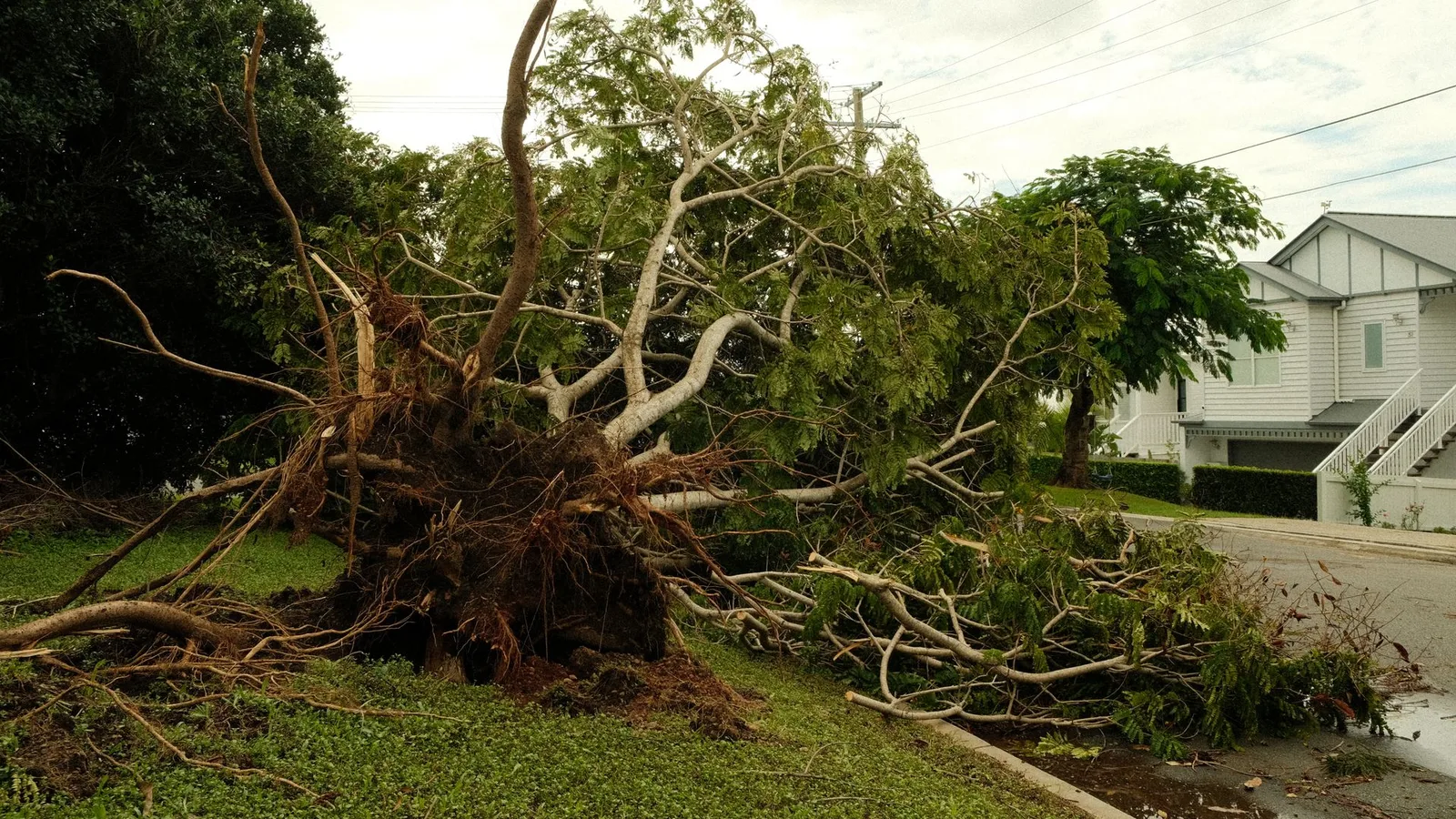
Homeowners insurance usually pays to remove a tree only when the tree has fallen on, and damaged, something your policy covers — your house, garage, fence or other insured structure — and the cause was a covered event such as wind, ice, snow or lightning. If a tree falls and hits nothing, or if you simply want a dead or leaning tree taken down before it fails, insurance generally does not pay, or pays only a small capped amount. Exact terms vary by insurer, so your own policy and declarations page decide.
Quick Answer: Is Tree Removal Covered? (Typical Policies)
- Storm drops a tree on your house or garage: usually covered — repair of the damage, and removal of the tree from the structure
- Tree falls but hits nothing: usually not covered; some policies pay a small capped amount for debris removal
- Tree blocks your driveway or access: covered under some policies, often with a low limit — check yours
- Dead, diseased or leaning tree removed before it falls: normally not covered — treated as maintenance
- Your deductible applies first — a small removal job often costs less than the deductible
- Replacing the tree: sometimes a small capped allowance; ask your insurer
Tree Down on Your House Right Now?
Stay clear, call us 24/7, and we’ll make it safe and document everything your insurer will ask for.
24/7 Emergency Service · ISA Certified · Fully Insured
📞 Call (585) 479-3388Serving Rochester & all of Monroe County since 2012
What This Guide Covers
- The Basic Rule: Did It Hit Something?
- Seven Common Scenarios
- Limits, Deductibles and What You Actually Get
- Whose Insurance Pays: Your Tree or the Neighbour’s?
- What Tree Removal Costs vs Your Deductible
- What to Do When a Tree Falls: 8 Steps
- What to Photograph and Keep
- Prevention: The Cheapest Insurance
- Questions to Ask Your Insurer
- Areas We Serve
- Frequently Asked Questions
The Basic Rule: Did It Hit Something?
Most standard homeowners policies insure against damage from named events — wind, ice, snow, lightning and similar — and a tree is just the thing that carries the damage. That leads to a simple test insurers apply:
| What Happened | Is Removal Typically Covered? |
|---|---|
| A covered storm drops a tree on your house, garage, shed or fence | Usually yes — repairs, and removal of the tree from the structure |
| A tree falls in a storm but lands on lawn, trees or open ground | Usually no, or a small capped debris-removal amount |
| A fallen tree blocks your driveway or a required access path | Sometimes, with a low limit — depends on the policy |
| A tree is dead, diseased or leaning, and you want it removed before it falls | No — treated as maintenance |
| A tree falls because of rot, disease or neglect the insurer can point to | May be denied as wear and tear or lack of maintenance |
A note on this guide: we are tree contractors, not an insurance agency, and policies differ. The figures and rules here are the commonly described patterns for standard policies. Always confirm with your insurer, and read your declarations page and endorsements.
Seven Common Scenarios
A storm tree lands on your roof
The strongest case for coverage. The policy generally pays to repair the roof and interior damage, and removal of the tree from the structure is commonly treated as part of that repair. Call your insurer first, then call us for emergency tree service.
A tree crushes the fence or shed
Other structures are usually covered under a separate “other structures” limit, which is lower than the limit on the house. Removal is typically included when the tree damaged the structure.
The tree fell on the lawn and hit nothing
This is the one that surprises people. With no damage to an insured structure, standard policies commonly pay nothing for cleanup, or only a capped debris-removal amount. GEICO notes that many policies limit this to around $500 per tree and $1,000 per incident, and that limits vary.
The tree is blocking the driveway
Some policies extend limited coverage when a fallen tree blocks a driveway or access ramp. If you cannot get a car out, say so when you phone the insurer, and ask.
You want a dead or leaning tree gone
Removing a hazard before it falls is considered upkeep, so there’s no claim. It is also the cheapest time to do it — see prevention.
A tree damages your car
Cars are normally handled under the comprehensive part of your auto policy, not your homeowners policy.
Ice or snow load breaks limbs but the tree stays up
Limbs that fall onto a covered structure are treated like a fallen tree. Limbs that fall onto open ground fall under the same debris-removal limits as scenario 3. Hanging, cracked limbs should be removed promptly either way. See our fallen tree removal service.
Limits, Deductibles and What You Actually Get
- The deductible comes off first. A policy may have a deductible anywhere from a few hundred dollars to several thousand. If removal costs $900 and your deductible is $1,000, the insurer pays nothing toward that bill — though a related roof repair may still push the total claim over the deductible.
- Windstorm deductibles can be a percentage. Some policies set a separate wind or hail deductible as a percentage of the insured value rather than a flat sum. Check yours.
- Debris limits are small. The commonly quoted pattern is a few hundred dollars per tree and about a thousand per incident when no structure was hit. Your policy may differ.
- Replacing the tree is rarely covered in full. Some policies give a small allowance for trees, shrubs and plants lost to certain perils; many do not cover replacement at all.
- Flood is excluded. A tree brought down by flooding is a flood claim, and flood needs its own policy.
- Making claims can affect your premium. Ask your insurer or agent before you file for a small amount.
Whose Insurance Pays: Your Tree or the Neighbour’s?
In most cases, your own policy covers damage to your own property, whichever yard the tree grew in. If your neighbour’s tree falls on your house in a storm, you generally claim on your policy, and your insurer may pursue the neighbour’s insurer if negligence is involved.
Liability arguments usually turn on whether the owner knew, or should have known, that the tree was dangerous. A healthy tree brought down by a storm is generally treated as an accident of nature. A tree that was visibly dead or decayed, and was ignored, can be treated as negligence. This is a legal question and varies, so ask your insurer or an attorney. A dated report from an arborist is useful evidence either way.
A dead tree you’ve been told about is a liability.
If a tree is dead or dying and a neighbour, a letter or an inspection has pointed it out, treat it as a known hazard. Removing it is far cheaper than defending a claim after it falls.
What Tree Removal Costs vs Your Deductible
Whether a removal is worth claiming depends on cost against deductible. Typical Rochester ranges:
| Job | Typical Cost |
|---|---|
| Standard tree removal | $300 – $3,500+ |
| Fallen tree removal | $200 – $3,500+ |
| Emergency or after-hours call-out | adds $200 – $500 |
| Crane-assisted removal (tree on a roof) | $1,500 – $6,000+ |
| Stump grinding | $150 – $400 per stump |
A tree on a roof that needs a crane will usually exceed any deductible, so claim it. A modest removal in the yard often won’t. Our tree removal cost guide explains what drives the price.
Need a Written Estimate for Your Claim?
We provide itemised, written estimates and photo documentation you can send straight to your adjuster.
📞 Call (585) 479-3388What to Do When a Tree Falls: 8 Steps
- 1Stay away and keep others away. A fallen tree can hold tension, shift without warning, or be tangled in service lines. Assume any wire is live. Call 911 if anyone is hurt or a wire is down.
- 2Photograph and film everything first. Do this before anything is moved. See what to capture.
- 3Call your insurer promptly. Report the claim, ask about your deductible and any wind deductible, and ask what documentation they want.
- 4Protect the property from further damage. Policies generally expect reasonable temporary repairs, such as tarping a hole. Keep the receipts.
- 5Call a licensed, insured tree service. Do not attempt it yourself. Removing a tree that is on a house is some of the most dangerous work there is. Ask for proof of liability and workers’ compensation insurance.
- 6Get an itemised written estimate and invoice. Separate the tree removal from the structure repair and from cleanup, because insurers pay these differently.
- 7Make it safe before waiting for the adjuster. If the tree is a danger, it’s reasonable to have it made safe straight away, provided you have photographed it and kept the invoice. Ask your insurer if you are unsure.
- 8Keep every record. Photos, estimates, invoices, emails and the claim number go in one folder.
What to Photograph and Keep
- The whole tree and where it landed, from several sides, before anything moves
- Every damaged area up close: roof, gutters, siding, windows, fence, interior ceilings
- The stump or break point — it shows whether the tree was sound or rotten
- The date and time, plus the weather (a screenshot of the forecast or alert helps)
- Anything the tree touched or blocked, such as a driveway or a service line
- The tree service’s written estimate, invoice and proof of insurance
- Photos of the tree before the storm, if you have any, showing it was healthy
The weather itself is part of a claim. The National Weather Service Buffalo office, which covers Rochester, issues the wind and winter storm warnings that show a covered event took place.
Prevention: The Cheapest Insurance
Because insurers generally won’t pay to remove a tree before it falls, an inspection and a planned job are your best protection. Warning signs a tree needs attention:
- Dead branches in the crown, or bark falling away in sheets
- Mushrooms or fungus at the base, or a hollow or cracked trunk
- A lean that has changed, or soil heaving at the base
- A V-shaped fork with bark pinched between two trunks
- Ash trees thinning from the top — possibly emerald ash borer
Options short of removal include cabling and bracing for weak forks and crown reduction to cut the weight and wind load. See our guides to crown reduction and cabling and bracing. Rochester trees face heavy lake-effect snow and ice, so inspect before winter, not after.
Questions to Ask Your Insurer
- What is my wind or hail deductible, and is it a percentage?
- What is my per-tree and per-incident debris-removal limit?
- Is removal from a structure part of the repair, or capped?
- Is there any tree-replacement allowance?
- Can I remove the tree before the adjuster visits?
- What documentation do you need?
- Do you cover temporary repairs?
- How will a claim affect my renewal?
If you believe a claim was handled unfairly, the New York State Department of Financial Services, which regulates insurers in the state, accepts consumer complaints at dfs.ny.gov.
Storm Tree Service Areas We Cover
We respond across Rochester and Monroe County, including Brighton, Pittsford, Greece, Webster, Henrietta, Irondequoit, Penfield, Fairport, Chili, Gates, Spencerport, East Rochester, Hilton and Churchville, plus nearby Finger Lakes towns. See every area we serve.
Tree Down? We’re Open 24/7
Fast response, itemised written estimates and photo documentation for your insurance claim. ISA Certified & fully insured across Monroe County.
📞 Call (585) 479-3388Not urgent? Request a free estimate
Frequently Asked Questions
Does homeowners insurance cover tree removal in New York?
Usually only when a tree has fallen on and damaged an insured structure such as your house, garage or fence, and the cause was a covered event like wind, ice or lightning. Removing a healthy, dead or leaning tree that has not caused damage is normally treated as maintenance and is not covered. Terms vary by insurer, so check your policy.
Will insurance pay to remove a fallen tree that didn’t hit anything?
Usually not. Many policies pay nothing, or only a small capped amount for debris removal. GEICO notes that many policies limit this to about $500 per tree and $1,000 per incident, though limits differ by insurer.
Does insurance cover removing a dead tree before it falls?
No. Preventive removal of a dead, diseased or leaning tree is considered routine maintenance, which standard homeowners policies exclude. Removing it early is also much cheaper than dealing with damage after it falls.
My neighbour’s tree fell on my house. Whose insurance pays?
Generally your own policy covers damage to your property, whichever yard the tree came from. Your insurer may then seek payment from the neighbour’s insurer if the neighbour was negligent, for example by ignoring a tree that was obviously dead. Ask your insurer for guidance.
Is the deductible applied to tree removal?
Yes. Your deductible is subtracted from the covered loss. If the removal costs less than the deductible, the insurer pays nothing toward it, although a larger combined claim including roof repair may exceed the deductible.
Should I remove the tree before the insurance adjuster arrives?
If the tree is dangerous or blocking access, make it safe straight away, but photograph and film everything first, keep the tree service’s itemised invoice, and tell your insurer. Ask the insurer if you are unsure what they require.
Does insurance cover a tree that falls on my car?
A car is normally handled under the comprehensive part of your auto insurance rather than your homeowners policy.
Does insurance pay for a replacement tree?
Rarely in full. Some policies give a small allowance for trees and shrubs lost to certain covered perils, and many give none. Ask your insurer what yours offers.
How much does emergency tree removal cost in Rochester?
Fallen tree removal in Rochester typically costs $200 to $3,500 or more, and emergency or after-hours call-outs add roughly $200 to $500. A tree on a roof that needs a crane can run $1,500 to $6,000 or more.
Can you give me paperwork for my insurance claim?
Yes. Branch Specialists provides itemised written estimates and invoices, photo documentation, and proof of insurance on request. Call (585) 479-3388, any time.
Sources and Further Reading
- GEICO — Does Homeowners Insurance Cover Tree Removal?
- Triple-I (Insurance Information Institute): consumer guides to homeowners coverage and claims.
- New York State Department of Financial Services: insurance regulator; consumer complaints.
- National Weather Service — Buffalo office: storm warnings for the Rochester area.
- Ready.gov: storm and disaster preparedness.
- City of Rochester — Forestry Services: street trees and tree requests.
- OSHA — Tree Care Industry: why tree work should be left to insured professionals.
- UDig NY (811): utility mark-out before digging.
- International Society of Arboriculture — TreesAreGood: tree-care information and arborist credentials.
- Background: Home insurance (Wikidata), Deductible (Wikidata), Arborist, Rochester, New York (Wikidata), Monroe County, New York (Wikidata).
Important: this guide is general information, not insurance or legal advice. Coverage depends on your insurer, policy form, endorsements and the facts of the loss. Cost figures are typical 2026 ranges for the Rochester, NY area and are estimates, not quotes.
“Insurance pays for the damage a tree does, not for the tree you saw coming. The cheapest claim is the one you never have to make.”
— Branch Specialists Rochester NY, ISA Certified Arborists