
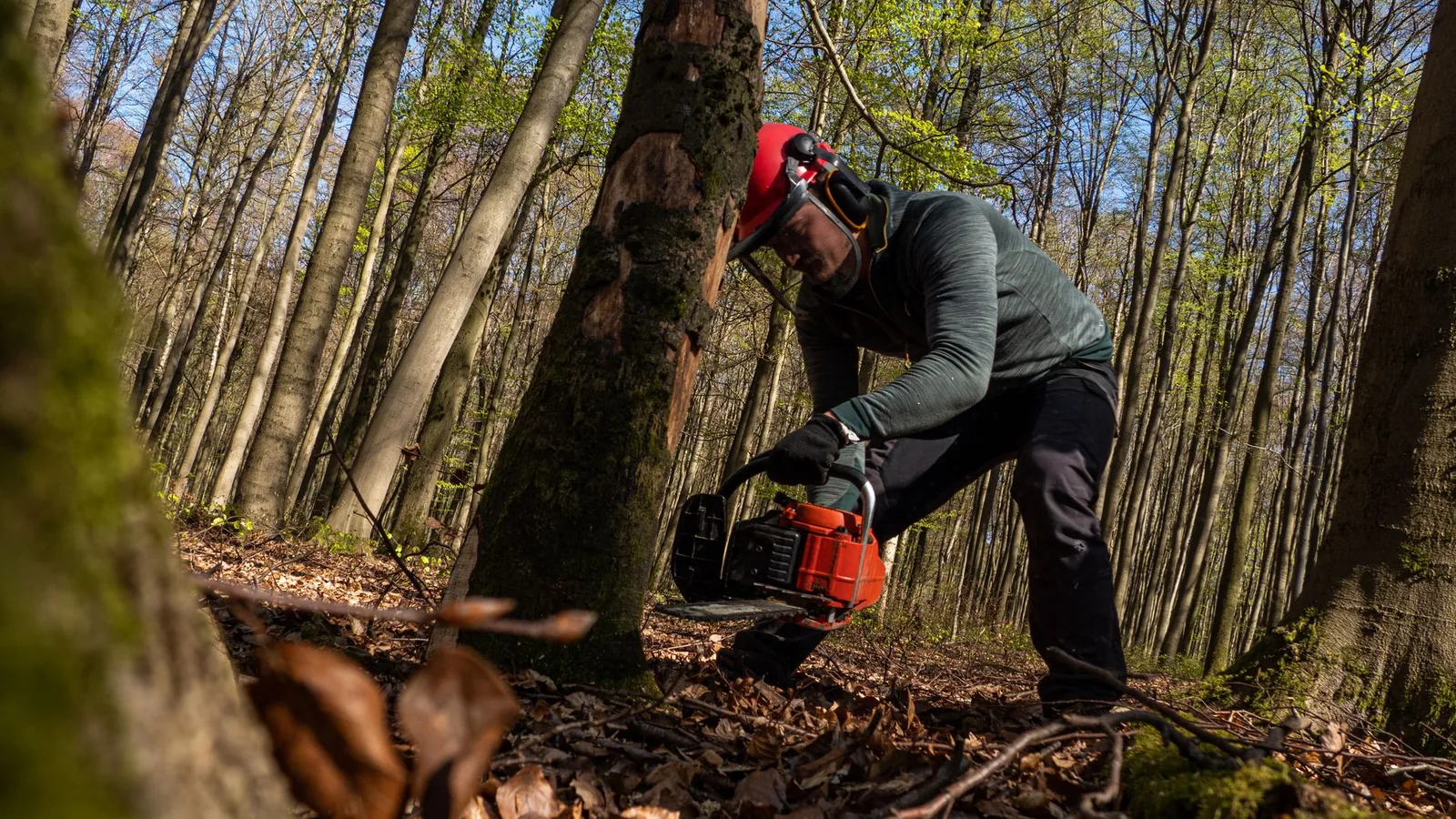
Think Your Ash Tree Is Dying?
Free on-site assessment from ISA Certified arborists. We’ll tell you honestly whether it’s a hazard — before winter ice makes the decision for you.
ISA Certified · Fully Insured · Free Estimates
📞 Call (585) 479-3388Serving Rochester & all of Monroe County since 2012
Quick Answer
- Emerald ash borer (EAB) is an invasive beetle that kills ash trees by tunnelling under the bark and cutting off water and nutrients.
- Look for thinning at the top of the canopy, D-shaped exit holes, bark splitting, heavy woodpecker activity and shoots sprouting from the trunk.
- Once an ash is dead it becomes brittle and unpredictable — far more dangerous to remove than a living tree.
- Don’t wait: a dead ash near a house, driveway or power line should come down before winter ice and wind load it.
- For a free assessment in Rochester or Monroe County, call Branch Specialists at (585) 479-3388.
What This Guide Covers
- What Is the Emerald Ash Borer?
- How to Tell If You Have an Ash Tree
- Signs Your Ash Tree Has EAB
- Why Dead Ash Trees Are So Dangerous
- Treat or Remove? Your Options
- When to Remove an Infested Ash
- How We Remove Dead Ash Safely
- What Ash Tree Removal Costs in Rochester
- Firewood & Disposal Rules
- Areas We Serve
- Frequently Asked Questions
If you have an ash tree in the Rochester area, there’s a good chance it is infested, dying, or already dead. Emerald ash borer has been established across Monroe County for more than a decade, and the standing dead ash it leaves behind are now one of the most common hazards our crews are called to. This guide explains how to recognise an infested ash, why a dead one is so much riskier than it looks, and what your realistic options are. Worried about a specific tree? Call us at (585) 479-3388 for a free assessment.
What Is the Emerald Ash Borer?
The emerald ash borer (Agrilus planipennis) is a small, metallic-green wood-boring beetle native to Asia. It arrived in North America in infested shipping material and, with no natural predators here to hold it back, has killed ash trees by the millions.
The adult beetle does little harm. The damage is done by the larvae, which feed just beneath the bark and carve winding tunnels through the tissue the tree uses to move water and nutrients. Enough tunnels and the tree is effectively strangled from the inside.
It attacks all of New York’s native ash species — white, green and black ash. According to the New York State Department of Environmental Conservation, ash makes up almost 8% of all trees in the state, which is why the impact has been so widespread.
How to Tell If You Have an Ash Tree
Before worrying about EAB, confirm the tree is actually an ash. Three features together are a reliable guide:
- Opposite branching — twigs and branches grow directly across from each other, rather than staggered along the stem. Few local trees do this.
- Compound leaves — each leaf is made up of 5 to 11 smaller leaflets arranged along a central stalk.
- Diamond-patterned bark — mature ash have tight, interlacing ridges that form a distinctive diamond pattern.
Not sure? Send us a photo or ask during a free estimate — identifying the species takes an arborist a few seconds.
Signs Your Ash Tree Has Emerald Ash Borer
Thinning from the top down
The upper canopy loses leaves first. Bare, dead branches at the crown while the lower tree still looks alive is the classic early pattern.
D-shaped exit holes
Adult beetles chew out through the bark leaving small holes about an eighth of an inch across, flat on one side like a capital D.
Woodpecker damage and “blonding”
Woodpeckers strip the outer bark to reach the larvae, leaving pale, flecked patches on the trunk. Heavy woodpecker activity on an ash is a strong warning sign.
Splitting bark and S-shaped tunnels
Vertical cracks open in the bark. Where it lifts away you can see the larvae’s winding, S-shaped galleries packed with sawdust-like frass.
Shoots sprouting from the trunk
A stressed ash pushes out clusters of leafy shoots low on the trunk or at the base — a last-ditch effort to keep growing as the canopy fails.
By the time you can see it, it’s well underway.
EAB usually infests a tree for a few years before symptoms are obvious from the ground. A tree showing clear canopy dieback is often already past the point where it can be saved.
Seeing These Signs on Your Tree?
Our ISA Certified arborists will inspect it and give you a straight answer on how much time it has — and how urgently it needs to come down.
📞 Call (585) 479-3388Why Dead Ash Trees Are So Dangerous
This is the part homeowners most often underestimate. A dead ash is not like other dead trees. Ash wood dries out and loses its strength unusually quickly once the tree dies, which creates three specific problems:
- They fail without warning. Large limbs and whole tops can snap off in ordinary wind, with no storm needed — and in a Rochester winter, ice and wet snow loading makes it far worse.
- They break unpredictably. Brittle wood doesn’t hinge or bend the way live wood does, so the tree won’t necessarily fall the way a cut is meant to send it.
- They can’t be safely climbed. A climber’s weight and rigging forces can shatter a trunk that looks solid. Long-dead ash generally has to be taken down from a bucket truck or with a crane instead.
That last point is why delay is expensive. An ash removed while it is declining but still structurally sound is a routine job. The same tree left standing dead for a few years becomes a specialist removal.
Treat or Remove? Your Options
- The tree is still healthy, with most of its canopy intact
- It’s a valuable shade or landscape tree worth preserving
- You’re prepared for repeat applications every few years
- A licensed pesticide applicator confirms it’s a good candidate
- A third or more of the canopy is already dead
- The trunk shows splitting bark or heavy woodpecker damage
- The tree stands over a house, driveway or power line
- It’s already dead — at that point it is only a hazard
Insecticide treatment can protect an ash that is still healthy, but it is preventive rather than a cure: it has to be applied by a licensed applicator and repeated for the life of the tree, and it will not bring back a tree in serious decline. For most ash in our area that are already showing symptoms, removal is the realistic option. A certified arborist can tell you which side of that line your tree is on.
When to Remove an Infested Ash
The short answer is sooner than feels necessary. Two things argue against waiting:
- The wood only gets weaker. Every season a dead ash stands, it becomes more brittle, harder to work on, and more likely to fail on its own.
- Winter is the high-risk season. Ice accumulation and heavy wet snow are exactly the loads brittle wood can’t carry.
Late fall and winter are good times to do it
With the leaves down there’s less debris, frozen ground protects your lawn from equipment, and the tree’s structure is easy to assess. If your ash is near a target, getting it down before the heavy weather arrives is the safest plan.
If a dead ash has already dropped limbs or is leaning toward a building, treat it as urgent — our emergency tree service runs around the clock.
How We Remove Dead Ash Trees Safely
- 1Assessment. An ISA Certified arborist checks how far the tree has declined, how sound the trunk is, and what it could hit — this decides the method.
- 2Choosing the method. Sound trees may still be climbed and rigged. Brittle ones are dismantled from a bucket truck or lifted out in sections with a crane, so nobody has to trust their weight to dead wood.
- 3Controlled dismantling. The tree comes down piece by piece, with every section lowered or lifted clear of roofs, fences and lines.
- 4Cleanup and stump. All wood and brush is hauled away, and we can grind the stump the same day so the spot is ready to replant.
What Ash Tree Removal Costs in Rochester
Price depends on the tree’s size, how far it has deteriorated, and what’s underneath it. As a general guide for Rochester and Monroe County:
| Tree | Typical Situation | Typical Cost Range |
|---|---|---|
| Small ash (under 30 ft) | Open yard, easy access | $300 – $600 |
| Medium ash (30–60 ft) | Standard residential removal | $600 – $1,200 |
| Large ash (over 60 ft) | Near structures, rigging needed | $1,200 – $3,500+ |
| Crane-assisted removal | Long-dead or over a building | $1,500 – $6,000+ |
Acting early saves money: the same ash generally costs less to remove while it’s still sound than after it has stood dead for several winters and needs a crane. We give a clear written estimate before any work starts.
Firewood & Disposal Rules
Moving infested wood is one of the main ways emerald ash borer spreads. New York regulates the movement of untreated firewood for exactly that reason, and EAB itself is listed as a prohibited invasive species in the state.
- Burn ash firewood locally — don’t take it to a cabin or campground elsewhere.
- If you’d like to keep the wood, tell us and we’ll cut it to length and leave it on site.
- Otherwise we haul everything away and dispose of it properly.
For the current rules, see the NYS DEC emerald ash borer page.
Ash Tree Removal Areas We Serve
We assess and remove ash trees across Rochester and the surrounding Monroe County communities, including Rochester, Pittsford, Greece, Webster, Brighton, Henrietta, Irondequoit, Penfield, Fairport, Spencerport, East Rochester, Chili, Gates, Hilton, and Churchville. See every area we serve.
Don’t Leave a Dead Ash Standing Through Winter
Get a free hazard assessment. ISA Certified & fully insured across Monroe County.
📞 Call (585) 479-3388Prefer we reach out? Request a callback
Frequently Asked Questions
How do I know if my ash tree has emerald ash borer?
Look for thinning and dead branches at the top of the canopy, small D-shaped exit holes in the bark, vertical bark splits, pale patches where woodpeckers have stripped the bark, and leafy shoots sprouting from the trunk. Any of these on an ash is worth an arborist’s inspection.
Can an ash tree with emerald ash borer be saved?
Sometimes, if it is caught early. A healthy ash with most of its canopy intact can be protected with insecticide applied by a licensed applicator and repeated every few years. Once a third or more of the canopy is dead, treatment is unlikely to work and removal is usually the realistic option.
Why are dead ash trees more dangerous than other dead trees?
Ash wood dries and loses strength unusually fast after the tree dies. Limbs and tops can snap in ordinary wind, the wood breaks unpredictably when cut, and the trunk often can’t safely support a climber — so long-dead ash usually has to be removed with a bucket truck or crane.
How much does it cost to remove an ash tree in Rochester?
Most removals fall between $300 and $3,500+, depending on size and location. A long-dead ash that needs a crane typically runs $1,500 to $6,000+. Removing the tree while it is still structurally sound is generally cheaper than waiting.
When is the best time to remove a dead ash tree?
As soon as practical, and ideally before winter. Dead ash becomes more brittle every season, and ice and heavy snow are the loads most likely to bring it down. Late fall and winter are also good working conditions, with leaves off and the ground frozen.
Can I keep the wood for firewood?
Yes, but burn it locally. Moving infested firewood spreads emerald ash borer, and New York regulates the movement of untreated firewood. We can cut the wood to length and leave it on site, or haul it away.
“The mistake we see most is waiting. An ash that’s dying is a normal removal. An ash that’s been dead three winters is a tree nobody should climb.”
— Branch Specialists Rochester NY, ISA Certified Arborists