
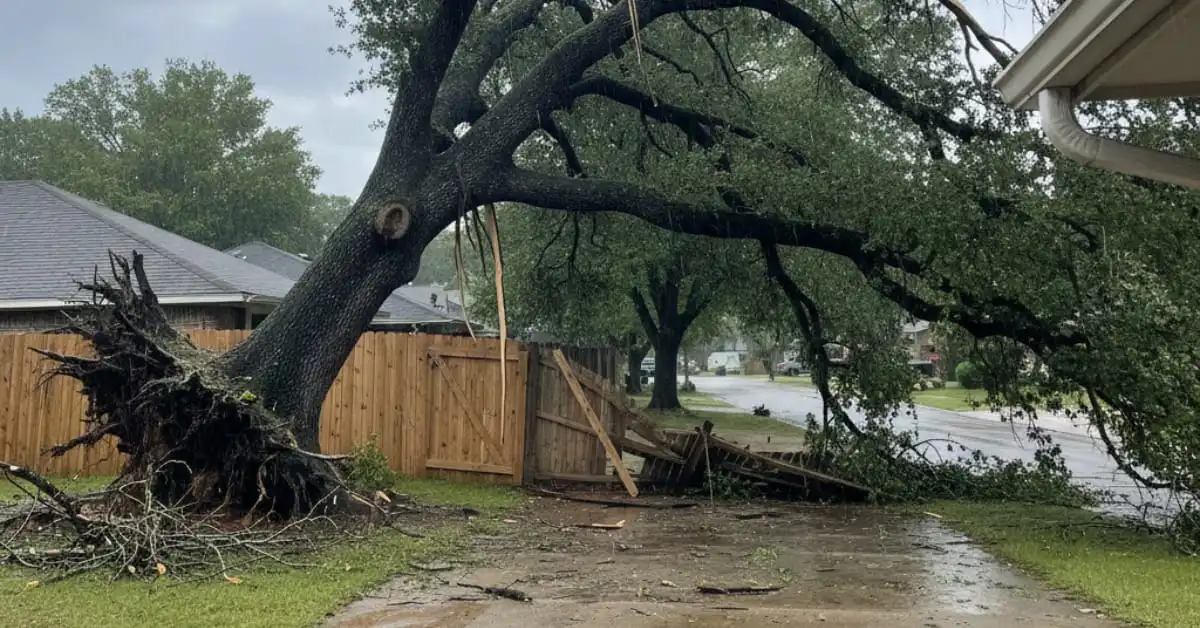
The trees are driving structures of nature, and bear the burden of environmental stress every year. Snow piled up like weight plates on trees, ground freezing its hold rapidly with each thaw, and the wind results in breaking weak branch structures.
Before a tree falls, it is already starting to crack like any other construction, slowly first appearing as cracks or maybe yellowed leaves.
These emergency tree warning signs are not melodramatic, but they are the final warnings. Therefore, timely identification of the symptoms of imminent tree failure will enable homeowners and property managers to act before they cause harm.
Understanding when a tree is hazardous and when emergency tree removal in Rochester is required can save unnecessary expenditure on fixing damage to a property or a loss of power supply, as well as severe security risks.
Warning Signs You May Need Emergency Tree Service in Rochester
1. Visible Structural Cracks
The cracks that run along the trunk or large limbs depict a weak internal support. These fractures make the tree have a lesser capacity to carry the burden of wind or snow loads.
Emergency service- Wondering if your cracked tree trunk needs repair or removal? Professional arborists determine the depth and direction of cracks and carry out controlled cutting in the trees to avoid abrupt splitting of the trunks in the event of high wind or massive snow.
2. Progressive Tree Lean
A tree with a higher lean is also likely to indicate a decrease in root strength, rather than natural growth orientation.
Emergency service- Emergency tree experts assess the risk of root failure and either add cabling or cut the tree down before the event occurs fully. These are common leaning tree danger signs you can easily observe.
3. Soil Separation at the Base
There are cracks that exist between the soil and the trunk, which demonstrates that roots are losing their grip, which makes the possibility of being ripped off.
Emergency service- Increase root plate stability- This is done during inspection, and emergency extraction is conducted in cases where the soil movement is likely to cause uprooting. This will assist homeowners in learning how to know if a tree will fall.
4. Heavy Canopy Weight on One Side
Imbalanced growth of the crown has the effect of overstraining a particular part of the trunk.
Emergency service In emergency crown reduction, the extra weight is eliminated by overloaded sections, and the balance is restored to the trunk and roots, avoiding extra strain. This is handled by professional tree trimmers in Rochester, NY.
5. Internal Rot Indicators
Internal decay is visible by signs like soft wood, hollows, or spongy trunks, which make it weaker. In most cases, this is a sign you need a tree removal in Rochester.
Emergency service- Arborists also employ decay detection techniques that are used to determine internal damage and to safely cut down trees that are no longer able to sustain themselves. The failure to act on it can heighten the risk of a dead tree falling.
6. Ice Accumulation Stress
The presence of ice-coated branches further increases the possibility of snapping or splitting, as it gives the branches a lot of weight.
Emergency service- Storm-response teams can remove ice-damaged or weight-stressed limbs to prevent them from breaking off and causing additional damage to property, particularly in storm-damaged trees in Rochester, NY.
7. Storm-Caused Limb Fractures
The branches that are not completely detached can fall later after drying, even days after a storm has passed.
Emergency service-Professionally, limbs are cut and lowered to the ground to eradicate delayed falling risks following storms.
8. Fungal Growth Along the Trunk
Fungi on the tree bark are usually signs of considerable decay that lies underneath the surface of the tree.
Emergency service-Emergency decay checks identify the degree of structural damage and inform hazardous removal prior to failure.
9. Exposed Structural Roots
If your tree’s roots are exposed to the surface above the ground, it is a warning sign indicating a threat to protection as well as stability, particularly during freeze-thaw periods.
Emergency service- Arborists consider the anchoring strength and carry out emergency mitigation or removal actions when the exposed roots pose a threat to stability.
10. Rapid Leaf Loss During Growing Season
Defoliation is sudden and might indicate high-stress levels or a serious disease condition. It may be a sign that a tree needs emergency removal.
Emergency service- Health and structural measurements determine the presence of internal decay as a threat to immediate safety that needs intervention.
11. Trunk Swelling or Bulging Areas
Unusual patterns of growth may be an indicator of initial failure points that develop under the bark.
Emergency service- The areas of internal pressure are checked, and the weak areas are cut before the trunk suddenly fails.
12. Past Lightning Strike Damage
There are trees that have been hit by lightning, and that seem to be stable at first, but in most cases, they weaken from the inside.
Emergency service- Structural inspection uncovers concealed internal damage, after which controlled dismantling is done in case of long-term stability problems. If a tree is a hazard that is prone to fall on a structure, arborists recommend a tree removal in Rochester.
13. Compacted or Eroded Soil
Too much compacted soil or eroded soil diminishes the oxygen supply to roots and the anchoring.
Emergency service- Root zone conditions are determined, and emergency hazard reduction is undertaken in case of reduced anchoring strength.
14. Branch Over extension Beyond Canopy
Thick limbs that stretch deep out of the crown enhance the leverage force when the winds are high.
Emergency service- Emergency pruning is targeted to decrease the stress of leverage and decrease the chances of branch failure in case of high winds.
15. Structural Damage from Construction Activity
Excavation or trenching root cuts lower the movement of nutrients and stability in the long term.
Emergency service- Arborists evaluate the disturbance of roots through excavation and either stabilize or remove them when the well-being of the tree begins to diminish at an alarming rate.
16. Repeated Pest Activity
Visible insect tunneling. It harms the vascular systems, making the branches and the trunk weak.
Emergency service- Structural examinations also identify the presence of insect infestations that have compromised important support structures and need emergency intervention.
17. Waterlogged Root Zones
Visible waterlogged root areas. Due to the long period of wet soil caused by snowmelt or heavy rainfall, roots are suffocated and ruined.
Emergency service- Identify which trees are prone to being uprooted.
18. Aging Tree Decline
Ancient trees lose their flexibility and strength in nature, thus being more susceptible to unexpected breakdowns.
Emergency service- The high-risk aging trees are proactively removed to avoid impromptu failures along the roadways or close to the houses.
19. Inadequate Past Pruning
Misplacement cuts may form poor attachment areas, which rupture when stressed. Also prone to diseases.
Emergency service- Arborists rectify unsafe cuts or remove structurally unsound limbs that have been produced as a result of poor pruning.
20. Proximity to High-Risk Areas
When the stability is reduced, trees situated in close proximity to homes, driveways, fences, or even the roadways become an emergency.
Emergency service- Rigging and sectional dismantling of trees is the solution. This helps to shield the surrounding buildings and utilities, which is usually offered by the 24-hour emergency tree service in Rochester, NY.
Why Rochester’s Climate Increases Tree Emergencies
In New York State, Rochester has one of the most adverse climates that affects the health of trees. The snow of the lake effect puts weight on the branches, and ice storms put the moisture directly on the limbs.
The spring thaw causes saturated soil, which makes the roots not very stable, and summer storms cause heavy winds that can blow down the trees. Temporary variations of the temperature also lead to soil expansion and contraction, which strains the root systems.
The combination of these factors contributes to the fact that early identification of emergency tree warning signs is important, instead of the collapse being visible before it starts.
Risks of Ignoring Tree Warning Signs
The inability to respond to the instability of trees may lead to broken fences, crushed cars, and blocked roads, as well as loss of power. Personal safety is also at risk because of falling trees and limbs. Unplanned events are usually costlier and more disruptive compared to prevention.
Protective measures will decrease liability, insurance concerns, and emergency response costs.
How much does emergency tree removal cost? It can be between 200$-3000$ based on the situation.
When to Call Emergency Tree Service Immediately
When a tree exhibits structural malfunctions, root destabilizations, or damage by storms, particularly when it is found close to structures or utility lines, emergency tree service in Rochester, such as Branch Specialists, must be called immediately. The equipment and training required to safely assess and remove dangerous trees are available to professionals in urgent conditions.
Conclusion
Emergencies with trees are not uncommon occurrences. Minor changes in makeup, soil quality, and development and stability are usually indicators of underlying issues that are forming in the long run.
The severe weather in Rochester also speeds up the stress experienced by trees, which makes early detection very important in ensuring safety and property is not compromised. Realizing such emergency tree warning signs and acting when necessary, homeowners will be able to avoid major damage as well as avoid emergency situations.
Active tree assessment and prompt emergency tree services in Rochester, like Branch Specialists, will give you the tranquility and security in your property in the long run.
FAQs
Q1:How fast should I contact Branch Specialists if I see this kind of sign?
This should be done immediately, particularly where the tree is close to buildings or where it has just been damaged by a storm.
Q2:Do people only need emergency tree services in Rochester during post-storms?
No. A lot of emergencies are caused by the gradual structural deterioration that turns into a hazardous situation without a storm.